Medical Education Abroad: Building a Strong Future
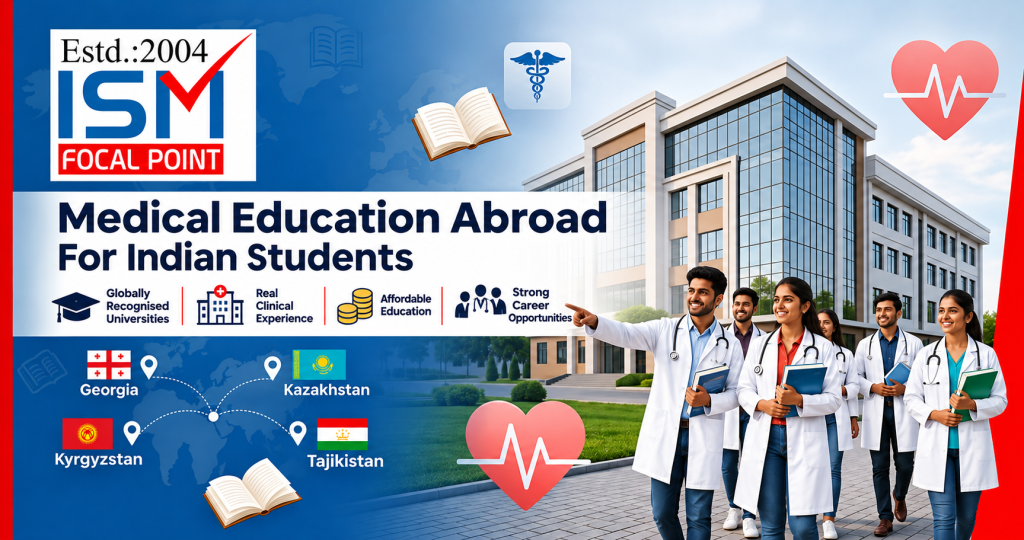
Students must be committed to a healthcare profession. Students can analyse and learn within global universities.
Indian students may want to analyse the medical universities, teaching and clinical experiences of other countries. Students must also understand the entry requirements and quality of medical universities together with the clinical experience and the legalities related to working as a doctor in India.
An expert education consultancy, such as ISM Focal Point, can therefore advise students and parents on how to analyse medical professions.
Students can both analyse and learn within global universities and can also analyse healthcare systems. Students can analyse medical universities in countries such as, Kyrgyzstan, Georgia, Kazakhstan and Tajikistan.
Students may wish to analyse the entry requirements, teaching and costs of medical universities within other countries.
Benefits of studying medicine in other countries are:
A suitable medical university will not only encourage good student learning but will also adhere to the relevant legalities for a student’s medical profession.
Analysing medical universities is a highly significant part of studying medicine in another country. Although students should analyse the reputation of a medical university, they should also analyse its teaching and clinical experience.
Students should analyse whether or not a medical university is legal and whether its medical qualification is suitable for the country that they wish to work in.
Indian students should in detail analyse the National Medical Commission’s Foreign Medical Graduate Licentiate Regulations, 2021 and any further associated guidance.
Although it may be stated that a medical university is on the World Health Organisation (WHO) list or is internationally recognised, the NMC advises that students should analyse medical universities themselves. The NMC does not recognise an international medical university list.
A suitable medical university will deliver high quality and diverse teaching. Likely areas of study include anatomy, physiology, biochemistry, pathology and pharmacology as well as clinical medicine.
Students should analyse the connection between teaching, laboratory work, demonstration and clinical experience.
Students should also analyse the language of instruction in which teaching is delivered. Although teaching in English can be advantageous for Indian students, students must also be ready to communicate in the local language so that they can effectively communicate with patients during clinical experience.
As well as analysing teaching, students and their families should analyse the costs of studying in another country.
These can consist of:
Students should analyse and create a plan for managing these costs so that families can efficiently handle financial matters and avoid financial problems.
To view analysis of medical universities, please refer to ISM Focal Point’s medical university analysis service.
Entry requirements will vary, not just between countries but also between medical universities. In addition, they will also depend upon Indian legalities.
Generally Indian students will have studied and achieved the required grades in Physics, Chemistry and Biology at higher secondary level. There is also a minimum age requirement.
Furthermore, Indian students WHO wish to gain an undergraduate medical qualification and then register as doctors in India should analyse their NEET qualification.
Students should analyse:
Although students may fulfil the entry requirements for a medical university, this does not automatically indicate that they will also adhere to the legalities of working as a doctor in India. Therefore both of these should be analysed and understood in separate detail.
For more information, please refer to the National Medical Commission’s legalities.
Different countries provide different learning settings, medical universities and living arrangements. A student’s ideal country for medical study will depend on their academic ambitions, financial situation and career aspirations.
Click here to analyse MBBS in Kyrgyzstan.
Kyrgyzstan is one country that Indian students analyse for medical study. Students should analyse medical universities in terms of their teaching, clinical experience, accommodation and legalities.
As well as providing international learning settings, Georgia also allows students to study medicine. Students should analyse the teaching language, clinical experience, curriculum and legalities of medical universities before selecting one.
Along with Kyrgyzstan and Georgia, students also analyse Kazakhstan for medical study. Students should analyse medical university resources, teaching staff expertise, teaching quality and costs.
Tajikistan is also analysed by Indian students as a possible medical study location. Students should analyse medical university legalities, curriculum, healthcare body connections and student support.
ISM Focal Point analyses medical education in these countries so that students can then analyse medical universities and decide upon which they would like to apply to.
As well as analysing teaching, students should also experience clinical practice. Students can then analyse and apply their medical knowledge and further develop their communication skills.
Clinical experience thus allows students to connect academic medical knowledge with genuine healthcare situations.
For instance, students can analyse cardiovascular disease within a teaching setting. Students can then analyse how doctors analyse a patient’s health, analyse diagnostic information and formulate a treatment plan; applying their academic medical knowledge in this way.
Students should analyse the following elements of medical universities before registering:
For Indian students, NMC legalities place great importance on analysing the duration of a medical studentship, internship and clinical experience together with the teaching language. According to the FMGL Regulations, 2021 students must complete a minimum of 54 months medical studentship and a minimum 12 month internship at the same overseas medical university. Further legalities also need analysing.
With the support of ISM Focal Point, students and parents can analyse and efficiently manage the different elements of medical study in other countries.
ISM Focal Point can:
Students can also analyse medical university entry requirements and seek advice from ISM Focal Point’s counselling service regarding their requirements.
Students must remain dedicated to their medical profession even after receiving a medical university place. Students should continue to focus on academic, clinical and professional progression. Students should also analyse the legalities of working as a doctor in their target country of work.
Parents should also be involved in analysing their child’s medical education. This especially applies to the analysis of medical university quality, cost and student wellbeing.
Students can effectively build a sound foundation for their future healthcare profession by thoroughly analysing medical education. If you are analysing overseas medical education, contact ISM Focal Point for advice on medical universities, entry and the support that you will require for your medical career progression.
Medical education abroad provides opportunities to study at international universities, experience different academic environments and gain exposure to diverse healthcare practices. Students can compare university facilities, course structures and education costs before choosing an institution that supports their academic and professional goals.
Indian students intending to pursue an undergraduate medical qualification abroad and seek medical registration in India must meet the applicable NEET qualification requirements. Students should check the latest NMC eligibility regulations before applying to a foreign medical university.
Kyrgyzstan, Georgia, Kazakhstan and Tajikistan are among the destinations explored by Indian students. Each country has different universities, tuition structures and academic arrangements. Students should compare individual institutions rather than selecting a country based only on affordability.
Students should evaluate the university's legal recognition, curriculum, course duration, clinical training, internship arrangements, teaching language and complete fee structure. Those planning to practise in India must also verify compliance with the applicable NMC regulations before paying admission fees.
ISM Focal Point assists students with university selection, admission guidance, visa procedures, pre-departure preparation and accommodation-related information. Its counselling services help students and parents understand available medical education options and plan their international admission journey.

Your Trusted Partner for Medical Education Abroad. ISM Focal Point (P) Ltd. has been guiding Indian students toward quality medical education abroad since 2005.
Copyright © 2026 ISM Focal point | Designed by Web Rocz